Key Takeaways
- A complete bridal jewellery set in 2026 has 7 essential pieces necklace, earrings, maang tikka, nath, bangles, mangalsutra, and rings plus 2 to 4 regional add-ons (kamarbandh, payal, bajubandh, bichiya).
- Spend 35 to 40 percent of your jewellery budget on the necklace alone. It’s the photographic anchor of every wedding picture you’ll have for forty years.
- Polki is not Kundan. Polki uses real uncut natural diamonds (heirloom-grade, holds value). Kundan jewellery is mostly glass stones set in gold foil (lighter, cheaper, doesn’t retain value). The price gap can be 5x to 10x.
- Lightweight 18K is overtaking heavy 22K for younger brides. The trade-off is comfort against traditional resale value.
- Always check the BIS hallmark and 6-character HUID code before paying. No exceptions, no excuses.
Indian bridal jewellery used to mean one thing: gold, lots of it, head to toe. That’s still true for many brides. But in 2026, “complete” looks different across regions, budgets, family customs, and the kind of bride wearing it.
A South Indian bride’s complete set looks nothing like a Punjabi one. A Moradabad bride splitting her budget between a wedding-day look and a sangeet look prioritises differently from someone wearing one set across the whole celebration. So forget the one-size-fits-all checklist. Here’s what we actually tell brides who walk into our Mandi Chowk store for a bridal consultation: nail the 7 essentials, then add what your tradition or outfit demands.
- Fun fact: In 2024, India officially overtook China as the world’s largest gold jewellery consumer. India’s bridal-driven gold demand pushed jewellery consumption to 563.4 tonnes against China’s 479.3 tonnes (World Gold Council Q4 + Full Year 2024 report). Bridal alone accounts for roughly half of India’s total gold jewellery consumption. So when you’re choosing your set, you’re not just picking jewellery you’re participating in the single biggest gold consumption story on the planet.
The 7 essential pieces every bridal set needs
1. The necklace (the photographic centerpiece)
This is where 35 to 40 percent of your jewellery budget should go. Whatever else changes across your wedding events, the necklace anchors every photograph. Two styles cover most North Indian brides in 2026:
- Choker + rani haar combo: A tight, ornate choker layered with a longer mid-chest necklace. Photographs beautifully because it fills the neckline and frames the face from any angle. The most popular North Indian bridal look.
- Single statement haar: One substantial piece (usually 30 to 60g of gold for a real piece) that does all the work. Better for petite brides or those wearing high-collared blouses.
Your blouse neckline decides the shape. A V-neck demands depth. A closed neckline demands a tight choker. A boat neck wants something delicate that doesn’t compete with the embroidery.
You can browse our gold necklace collection for reference shapes before you come in.
2. Earrings (because they’re in every photo)
Earrings get worn for the longest stretch of any piece. From mehendi to morning-after rituals, they’re rarely off your ears for four or five days straight. Comfort matters more than most brides realise until day two of swelling earlobes.
The two earring shapes that work for most bridal looks:
- Chandbalis: crescent-shaped, traditional, work with most outfits and necklaces
- Jhumkas with kaan-chains: bell-shaped jhumkas with a chain hooking into the hair, which distributes weight away from the lobe and stays comfortable for long hours
If your necklace is heavy, keep earrings simple. If your necklace is a single statement piece, go bigger on the earrings. Don’t compete with yourself.
3. Maang tikka (the forehead piece)
Worn at the parting of the hair, hanging onto the forehead. The traditional placement aligns with the agya chakra, the so-called “third eye” in yogic tradition.
For most brides this is a smaller-budget piece, usually under 10 percent of the total set. The maang tikka pairs better with the earrings than the necklace. Brides who match it to the necklace usually end up with too much going on at the top of the face.
4. Nath (the nose ring)
The big traditional piece. Connects from the nose stud to the ear via a chain, originated in Mughal-era India, and never really left North and West Indian bridal looks.
Two quick decisions to make in advance:
- Pierced or clip-on? Clip-ons are now indistinguishable in photographs. If your nose isn’t pierced and you don’t want to pierce it for the wedding, the clip-on is genuinely fine.
- Chain or no chain? A chain pulls the entire face look together but adds weight on the ear. A standalone nath is lighter and lets the nose stud breathe.
5. Bangles, kada, and chooda
Regional traditions take over here:
- Punjabi brides wear chooda — traditionally a set of red and ivory bangles given by the maternal uncle (mama). Worn for at least 40 days post-wedding, sometimes up to a year and a quarter (1.25 is considered an auspicious span in Punjabi tradition).
- UP and Bihar brides typically wear gold kada, sometimes with stone work, alongside stacks of plain gold bangles.
- South Indian brides wear vanki and gold bangles with temple motifs.
For Moradabad and surrounding North-Western UP brides, the standard look is 4 to 8 gold bangles per arm, often paired with a single statement kada. Gold weight per arm typically runs 30 to 80g depending on budget. Heavier looks great in photos. Lighter is what you’ll actually wear after the wedding.
6. The mangalsutra
The non-negotiable piece. The black beads carry meaning beyond decoration; they signify protection from negative energy in Hindu marriage tradition. Modern designs include diamonds and coloured stones, but the black beads stay.
Two practical thoughts before you buy:
- Many brides buy a “showy” wedding-day mangalsutra and a separate “everyday” one. If budget allows, this is smart. The wedding piece is heavier and rarely worn after.
- Keep at least 2 detachable links built into the chain. If you ever need to extend or shorten it, this saves a full remake.
7. Wedding rings and finger jewellery
The engagement ring (often a separate event), the wedding band, and sometimes hath phool the hand ornament that connects rings on each finger to a bracelet at the wrist.
For Moradabad brides especially, hath phool is having a quiet comeback in 2026. Extends the bridal look across the entire hand and photographs spectacularly with mehendi.
The add-ons (regional and outfit-specific)
These aren’t required for everyone. They’re tradition-driven or outfit-driven:
- Kamarbandh (waist belt): essential for South Indian brides, optional but trending again for North Indian brides in 2026, especially with high-waist lehengas.
- Payal (anklets): symbolic in some Hindu traditions, mostly silver, occasionally gold. Often skipped on the wedding day itself but worn during haldi and mehendi.
- Bajubandh (armlets): worn on the upper arm, perfect with sleeveless or off-shoulder blouses. Trending again with sangeet outfits in 2026.
- Bichiya (toe rings): worn on the second toe of each foot in many North Indian Hindu traditions, usually silver, sometimes gold.
Polki, Kundan, gold, or diamond — which one to actually buy?
This is where most brides get lost. Sales staff use these terms loosely. The differences are real and they matter for both your look and your money.
💎 Fun fact: Polki and Kundan are not the same thing, even though they’re routinely sold as if they were. Polki uses real uncut natural diamonds set in gold investment-grade, retains value, heirloom-worthy. “Kundan jewellery,” in colloquial trade, almost always means glass stones set in 24-karat gold foil (which is technically what “kundan” means: highly refined gold). A well-made Polki necklace can cost 5 to 10 times what a similar-looking Kundan piece costs (cross-verified in pieces by Natural Diamonds Council and multiple jeweller-side sources). The price gap is real, even when the visual impact looks similar.
So here’s the practical breakdown for a 2026 bride:
- Plain gold (22K): Heaviest, most traditional, best resale value. The safest financial bet for the necklace and bangles core.
- Polki: Real uncut diamonds in gold. Looks vintage and regal. Heavy. Holds value. Best as the necklace centerpiece if budget allows.
- Kundan: Bright, colourful, glossy. Lighter on the wallet and the body. Excellent for sangeet or reception sets where you want grandeur without the price tag.
- Diamond: Cleaner, more modern. Sparkles harder than Polki. Best for the engagement piece, the everyday mangalsutra, or a single statement set across multiple events.
The most common 2026 split we see at our Mandi Chowk store: a heavy 22K gold necklace for the wedding day, a Polki or Kundan choker for sangeet, and lightweight 18K diamond pieces for engagement and reception. That stack covers four functions without doubling up.
Budget allocation: how to actually split it
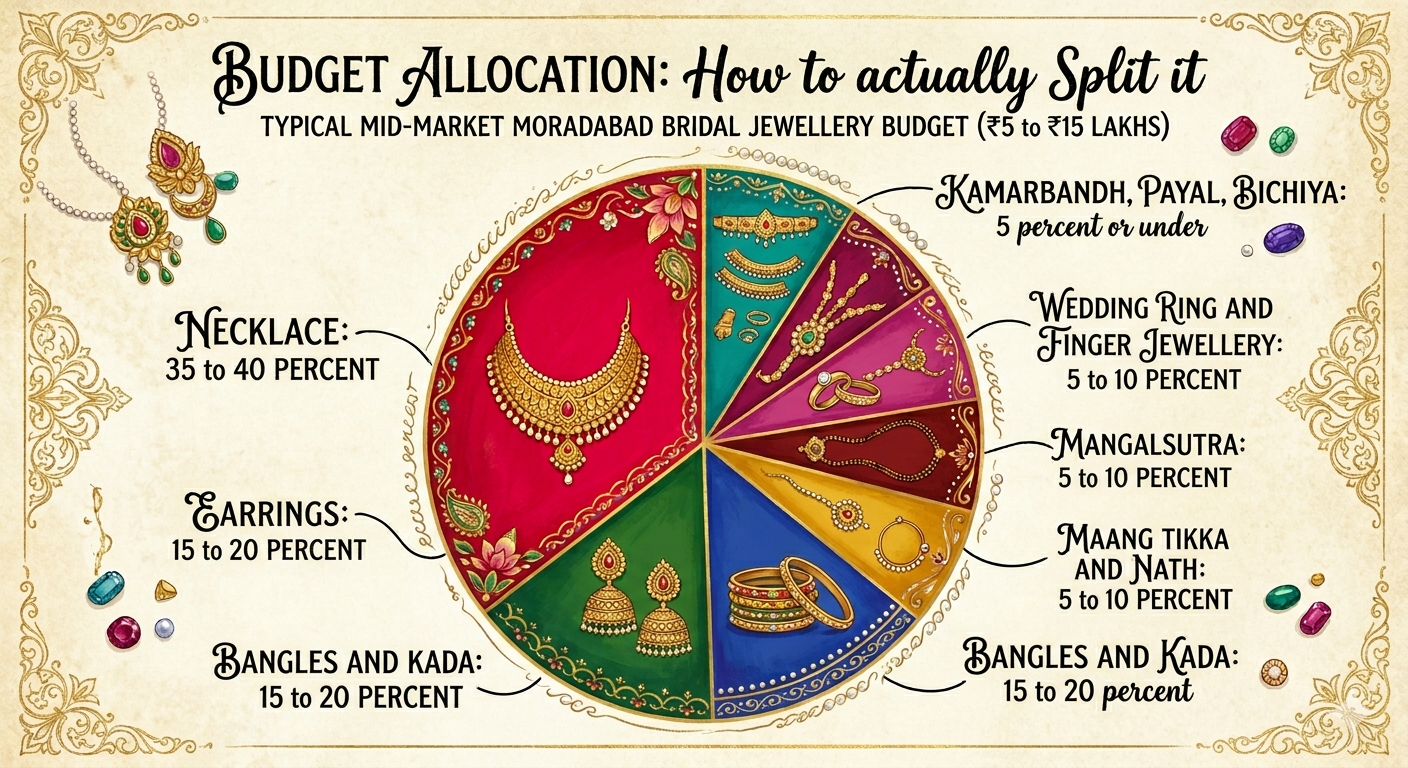
Working with a typical mid-market Moradabad bridal jewellery budget of ₹5 to ₹15 lakhs, here’s how brides usually allocate it:
- Necklace: 35 to 40 percent
- Earrings: 15 to 20 percent
- Bangles and kada: 15 to 20 percent
- Maang tikka and nath: 5 to 10 percent
- Mangalsutra: 5 to 10 percent
- Wedding ring and finger jewellery: 5 to 10 percent
- Kamarbandh, payal, bichiya: 5 percent or under
These aren’t rules. They’re reference points. The principle: don’t let any one piece eat more than 40 percent of the budget unless you’ve consciously decided that piece is the heirloom investment. And don’t pad accessories at the cost of the necklace.
What’s changing in 2026: trends actually worth following
Most “trend” articles are noise. Here are four shifts we’re seeing actually stick at our Mandi Chowk store:
1. Lightweight 18K replacing heavy 22K for younger brides. A 22K necklace at 80g versus an 18K at 50g, same visual impact, better comfort, lower price. The trade-off: 18K has lower resale value because it’s only 75 percent gold against 91.6 percent for 22K. If you’ll keep the piece for life, 22K wins. If you might remake it later, 18K wins.
2. Detachable and convertible pieces. A choker that extends into a haar. Earrings that detach into studs and chandbalis. A maang tikka that converts into a pendant. Demand for this has tripled in two years. Brides want pieces they’ll actually wear after the wedding, not just on it.
3. Mixing real and high-quality artificial. Real heavy gold and Polki for the main wedding ceremony, paired with high-grade artificial Kundan or American diamond for smaller events. Budget goes 80 percent to real, 20 percent to spectacle pieces. The smartest budget shift we’ve seen in years.
4. Polki gaining over Kundan as resale awareness grows. With gold prices at all-time highs through 2025 and into 2026, more brides are choosing one investment-grade Polki piece over multiple Kundan sets. Bridal jewellery is being treated more as inheritable wealth and less as one-time adornment.
Hallmark and certification: the non-negotiable
Every gold piece you buy must carry four marks:
- The BIS triangular logo (the standard mark)
- The purity grade: 916 for 22K, 875 for 21K, 750 for 18K, 585 for 14K, or 375 for 9K
- A 6-character alphanumeric HUID (Hallmarking Unique Identification)
- The jeweller’s identification mark
Frequently asked questions
What is included in a complete Indian bridal jewellery set?
A complete bridal set typically has 7 core pieces: necklace, earrings, maang tikka, nath, bangles or chooda, mangalsutra, and rings. Regional add-ons include kamarbandh (waist belt), payal (anklets), hath phool (hand ornament), bajubandh (armlets), and bichiya (toe rings). North Indian brides usually emphasise the nath; South Indian brides add vanki and oddiyanam.
How much does a complete bridal jewellery set cost in 2026?
Mid-market complete sets in Moradabad and similar cities typically range from ₹5 to ₹15 lakhs. Polki-heavy luxury sets can run ₹25 lakhs and above. Budget-conscious sets blending real and high-quality artificial can start around ₹2 to ₹3 lakhs. The biggest cost variable is gold weight, followed by Polki content.
Should I buy 22K or 18K for my bridal jewellery?
22K (916 purity) holds better resale value and is more traditional, but it’s softer and heavier. 18K (750 purity) is harder, lighter on the wrist, and costs less for the same visual size, but resale is lower. For pieces you’ll keep for life or hand down, choose 22K. For pieces you might wear regularly post-wedding or remake later, 18K works better.
What’s the actual difference between Polki and Kundan jewellery?
Polki uses real uncut natural diamonds set in gold. High value, heavier, holds worth as an heirloom. “Kundan jewellery” almost always means glass or semi-precious stones set in 24K gold foil. Beautiful and lighter, but doesn’t retain monetary value. They look similar in photos. Their price tags absolutely do not.
When should I start shopping for my bridal jewellery set?
Start at least 3 to 6 months before the wedding. Customised pieces need 4 to 8 weeks at the karkhana plus fitting time. During peak wedding season (mid-November through March), book consultations even earlier. Slots fill up by October at most serious Moradabad jewellers, ours included.
Can I mix real and artificial jewellery for my wedding?
Absolutely, and many brides should. The standard 2026 approach: real gold and Polki for the main wedding ceremony, high-quality artificial or Kundan for sangeet, mehendi, and haldi. This keeps the budget sane while letting you wear different complete looks across each event.
Is Moradabad a good place to buy bridal jewellery?
Yes, particularly for hallmarked traditional gold sets and customised work. Mandi Chowk has been a jewellery district for generations, with karkhanas attached to most reputable shops, which means custom design and repair work happens locally rather than being outsourced. Pricing is typically 5 to 10 percent below Delhi or Lucknow for comparable hallmarked work.
Ready to start building your bridal set?
The right way to plan a complete bridal jewellery set isn’t to memorise a checklist. It’s to sit down with someone who can show you 6 to 10 actual options across price points, suggest what works for your outfit, and tell you honestly which pieces deserve your budget and which ones don’t.
That’s exactly what a bridal consultation at our Mandi Chowk store is built for. WhatsApp us your wedding date and rough budget at +91 9412248026, and we’ll send you a slot.Browse the full bridal collection before you come in, and read more about our atelier.